In today’s topic, we want to briefly touch what vectors and what linear combinations are. There are 3 questions we are trying to answer in this blog.
- What is vector?
- What is linear combination?
- What is dot product between vectors?
1: Before we talk about vector, we have to know what is scalar. A scalar is a quantity that is fully described by a single value without any direction. In physics, scalars often used to represent quantities that only have magnitude, size such as:
- temperature 25 C
- mass: 5 kg
- time: 10 sec
Scalars follow the rules of ordinary arithmetic. They can be added, subtracted, multiplied, and divided in a straightforwad manner.
Vectors is a quantity has both magnitude and direction. The most familiar vectors are quantities have these two characteristics such as:
- displacement: 5 meters to the south
- velocity: 20m/s east
- force: 10 N upwards
Mathematically, vectors are often also represented by an arrow, where the magnitude is represented by the length of the arrow, and the direction of the vector represents the direction of the quantity. In terms of operations, vectors have their own set of operations such as vector addition, scalar multiplication, dot production and cross product.
2: linear combinations:
For one vector, the only linear combinations are the multiples with a constant cu. For two vectors, the linear combinations are cu+dv. For three vectors, the linear combinations are cu+dv+ew. The addition of two vectors is the sum of each component of each vector. Such as for a 2D vector v+u = (v1,v2)+(u1,u2) = (v1+u1, v2+u2). The scalar multiplication of a vector is multiply each component of the scalar. Those two basic operations are able to product all the linear combinations as described.
3: dot product:
We have not mentioned the multiplying between vectors. The multiplication involves the separate products v1u1 and v2u2, and add the summation to produce one single number. For example:
v dot u = v1u1+v2u2
The order of the dot product makes no differences. A special case of dot product is the vector with itself. In the case v equals w. For example, v = (2,1), the module squared ||v||2 = (2,1)*(2,1) = 4+1=5. If we image put vector v in a cartesian coordinate system. The module of v is actually the square sum of a triangle, which give the length of the third side of the right angle triangle squared. So the length of v, module of v, is the square root of the dot product of vector itself. Accordingly, we can definite the unit vector is a vector whose length equals to one. Then v dot v = 1. We can easily convert a non-unit vector to a unit vector by dividing the length of the vector itself.
The geometry picture of dot product is the angle between two vectors, and it is cos(theta). The picture below shows when the vectors are u=(cos(theta), sin(theta)), and i=(1,0). The dot product is u dot i = cos(theta). This is the cosine angle between them. For a more general situation, For any arbitrary unit vectors, the vector u=(cos(alpha), sin(alpha)), and vector v =(cos(beta), sin(beta)), with beta=alpha+theta. Their dot product is cos(alpha)cos(beta)-sin(alpha)sin(beta). From the trigonometry this is cos(beta-alpha) = cos(theta).
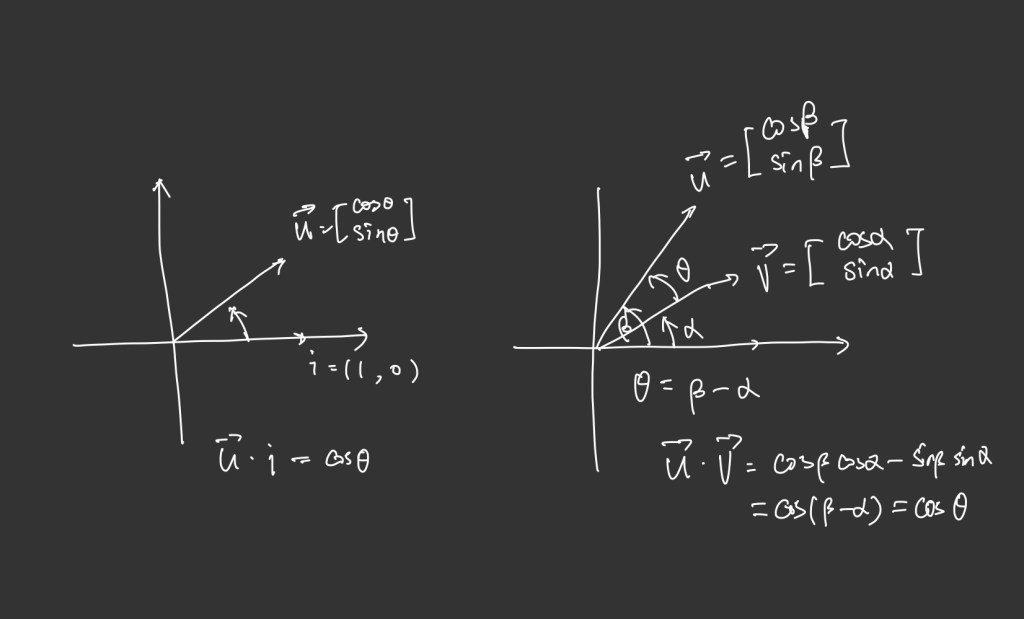
In summary, the dot product actually tells us directly the angle between two vectors.
 CFDSHARE